

An overview of Bengal's health indicators show that the state has been relatively stagnant in key health indicators, while being in a relatively worse position than earlier for some, compared to the rest of the country and other states. Since the RG Kar incident and ensuing protests in 2024, Mamata Banerjee's role as Minister in Charge Of Health and Family Welfare has been highlighted by the political opposition and civil society. Reports and anecdotal experiences have shown poor infrastructure quality in hospitals, improper monitoring and coverage of the state's Swasthya Sathi medical insurance scheme and other lapses in health infrastructure. West Bengal shows an especially bad situation for the Maternal Mortality Rate, which was consistently much below the national average during the Left Front rule, but has alarmingly risen above the national average during 2017-20, where it currently stands.
All states, and the nation as a whole has seen absolute improvements in health indicators since the early 90s and 2000s. However, several subnational variations exist, with states such as Kerala, Tamil Nadu and Maharashtra being considerably well-performing while states such as Uttar Pradesh and Bihar appearing consistently on the lower end. Notably, a state-wise comparative analysis indicates the relative efforts taken by states given their initial base, and helps for comparing a state's own performance over time, as well a state's performance against other states during the same time period.
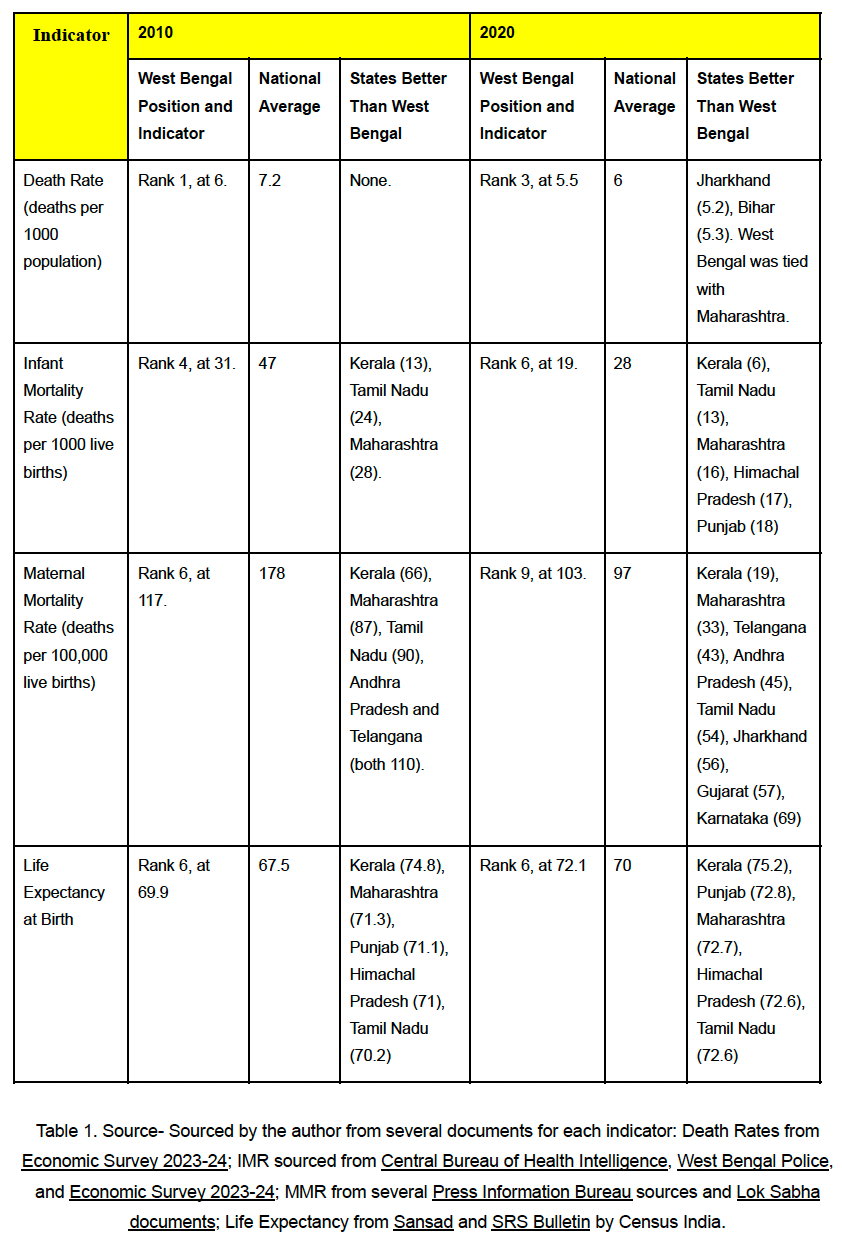
In 2010, West Bengal ranked 4th in Infant Mortality Rate (IMR), and 6th in Maternal Mortality Rate (MMR, for 2007-9-10). Under the then Left Front government, West Bengal was considerably better than the national average for IMR and MMR, as shown in table 1. The crude death rate (while it should not be considered the best health indicator, but taken in context with others) in West Bengal was the highest in 2010, at 6 per 1000 population. The health performance of the Left Front government at the time was said to suffer from low public spending and poor infrastructure, which the Buddhadeb Bhattacharya ministry had addressed around the early 2000s. Around this time, is when West Bengal saw steady improvements in Life Expectancy, IMR, MMR, Death Rate and healthcare infrastructure. Of the top 5 large states by population. West Bengal was better than Bihar, Uttar Pradesh and Andhra Pradesh, and a close second to Maharashtra. It should be noted that of these states, Bengal saw comparatively greater refugee influxes in the 70s and 80s and dealt with famine conditions around the same time. This is expected to have been a burden on the state's healthcare conditions, which other comparatively large states did not experience. When TMC assumed power in 2011, they inherited a healthcare ecosystem of relatively decent health indicators.
From 2011, absolute improvements in health indicators by the All India Trinamool Congress (TMC) government did not reflect the erstwhile relative position of West Bengal compared to India and other states. This indicates that other states which were once worse off than Bengal, progressed at a faster rate compared to their initial level on indicators. Table 1 highlights the relative position of key health indicators between 2010 and 2020 (the most recent year for Sample Registration System 2021 bulletin published in 2025). West Bengal's rank went down for all indicators except Life Expectancy, relative to the rest of the country and its position in 2010. During these years and except for the death rate, other states such as Kerala, Tamil Nadu, Maharashtra have retained their relative positions while states such as Punjab, Gujarat, Haryana and Himachal Pradesh have caught up. Notably, West Bengal's relative position was either lower or the same for every key indicator, and not once did it improve on the relative position during the 2000-10s.
Family Health Indicators: Relative Stagnation in Neonatal Mortality And a Worsening Performance for Maternal Mortality
During the tenure of Mamata Banerjee, as the Minister in Charge for Health and Family Welfare, relative performance of Bengal in key family health indicators was poorer compared to their initial base, and the speed at which other states caught up passed Bengal. The most notable of this is in the Maternal Mortality Rate (MMR, number of maternal deaths per 100000 live births, see table 2), which was considerably below the national average and other states during the tenure of the Left Front. West Bengal ranked 6th in 2010-12, only behind Kerala, Tamil Nadu, Maharashtra, Telangana and Andhra Pradesh. After 2011, Bengal's rank rapidly deteriorated each year, ending at 9th in 2020. For 3 straight periods from 2015-17, 2016-18 and 2017-19, the MMR went up (see Figure 1). By 2020, Bengal's MMR was alarmingly above the national average, for the first time in the 21st century. Around 2011-13, Gujarat overtook Bengal with a lower MMR (figure 1).
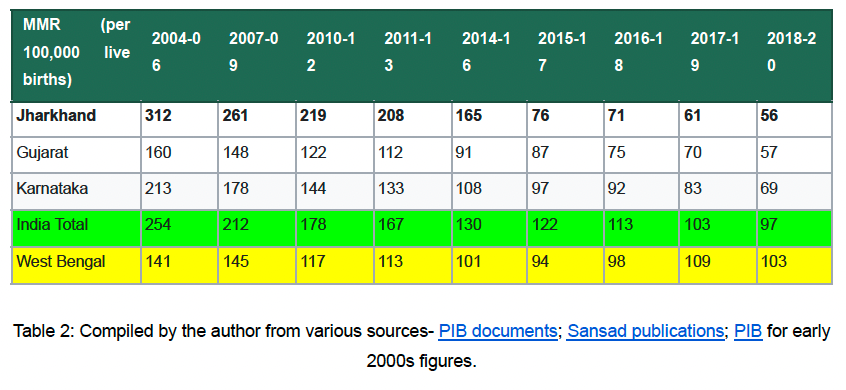
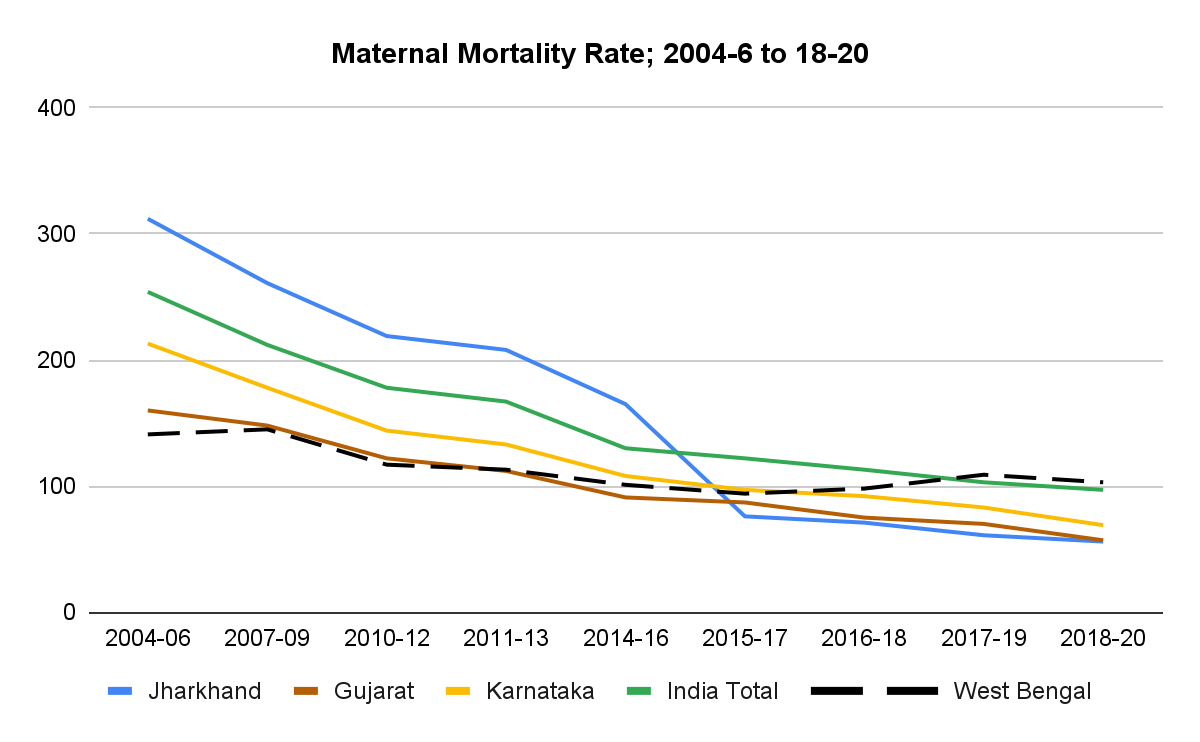
The trend shows a stagnancy beginning 2011-13, compared to a steep decline for the country, and other states. It should be noted that achieving an under 100 MMR was a goal by the National Health Policy, which India has achieved. Of this, Bengal had an under 100 MMR for only two periods, before rising above 100. 8 other states have achieved the SDG target of a below 70 MMR - Kerala (19), Maharashtra (33), Telangana (43), Andhra Pradesh (45), Tamil Nadu (54), Jharkhand (56), Gujarat (57) and Karnataka (69). West Bengal was performing better than the latter 3 states in 2010-12 (figure 1).
The "Three Delays" Model
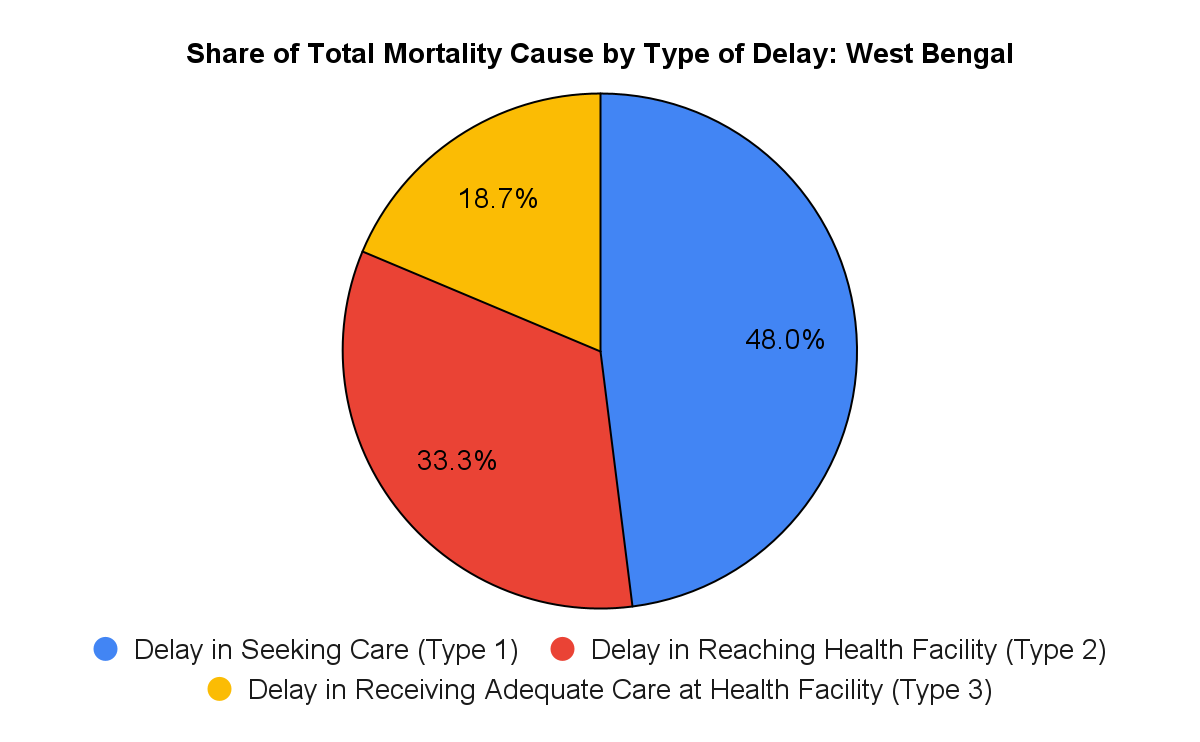
A study conducted in 2019 in West Bengal attributed the maternal mortality in West Bengal to the "three delays" model, which identified three kinds of delays in availing critical maternal care, resulting in death. The delays were: type 1- delay in seeking care; type 2- delay in reaching health facility; type 3- delay in receiving adequate care at health facility. The share of total mortality caused by delay is shown in Figure 2 below, where type 1 caused the greatest mortality. This indicates a situation of inadequate non-health infrastructure, that results in health related adverse effects. This resonates with popular research that highlights that urban and social infrastructure may not have been as much of a realised priority for West Bengal, and especially rural infrastructure which critics have continued to deem significantly poor.
Neonatal Mortality Rate Stagnation
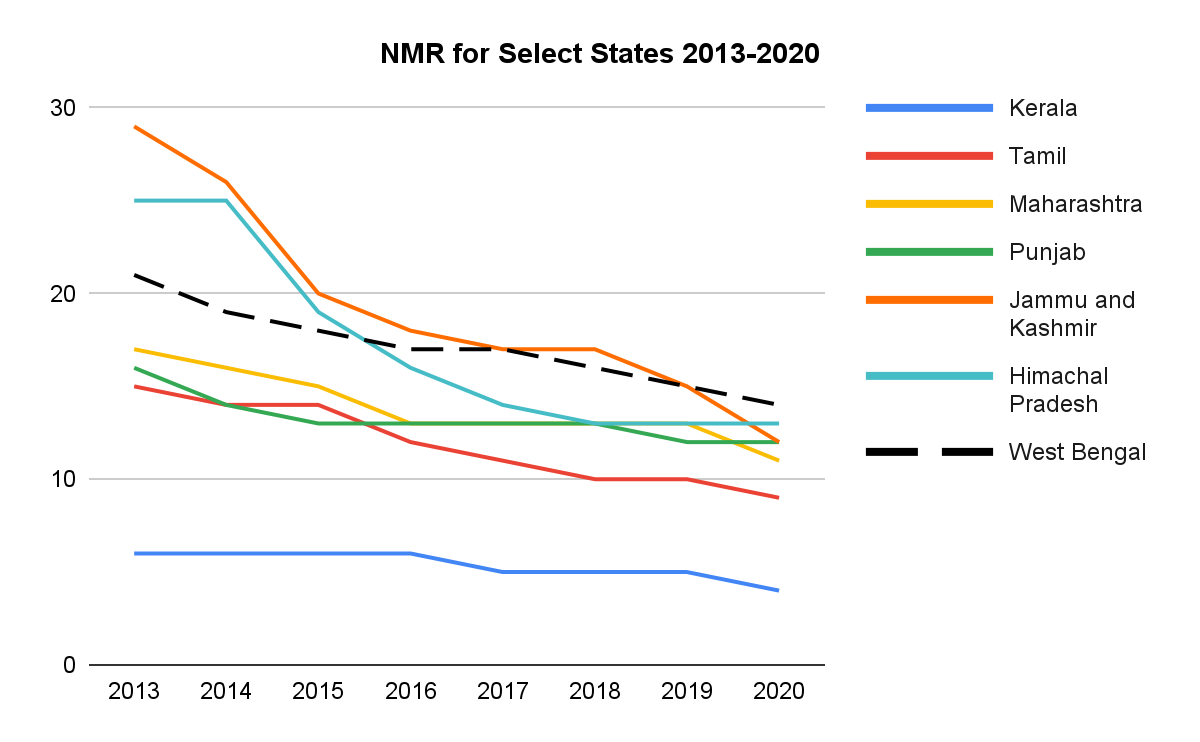
A similar trend of relative poor performance can be seen for the Neonatal Mortality Rate (NMR, number of deaths per 1000 births), where Bengal was ranked 5th in 2013 for major states (based on SRS data, the data for 2010-12 is unavailable or unreliable). In that time, among comparable big states, Bengal was behind only Kerala, Tamil Nadu, Maharashtra and Punjab. By 2020, Himachal Pradesh and Karnataka had overtaken Bengal, with its rank dropping to 7th among key big states.
Institutional Deliveries: Overtaken by Peers
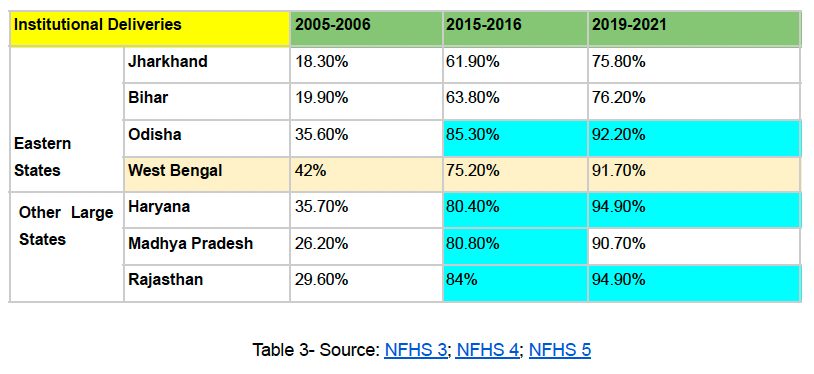
Another key indicator for family healthcare is the share of institutional deliveries, as home deliveries are prone to birth-related risks. For this, a comparison of Eastern States, which share similar demographics, inter-state migration, pressure on infrastructure and climate, shows that in 2005-6, West Bengal was ranked 1st at 42% institutional deliveries, among the Eastern states of Jharkhand, Bihar and Odisha. While Bengal was above the national average for all periods, among other comparable large states, in 2005-6, West Bengal had a higher share of births in a health facility than big states such as Rajasthan, Haryana and Madhya Pradesh. By 2015-16, Odisha (at 83%) had improved more than West Bengal (75%), and Bengal was also overtaken by Rajasthan (84%), Haryana (80.4%) and Madhya Pradesh (80.8%). As of 2020, West Bengal lagged behind Odisha, Haryana and Rajasthan (states better than West Bengal are coloured in blue in table 3).
Healthcare Infrastructure: Building on A Relatively Strong Base
An area where the TMC has made minor improvements are in healthcare infrastructure of the state. However, it should be noted that the state had a strong existing base in 2010, regularly ranking in the top 5 major of the country when it came to hospital bed to population ratio, and a significantly large number of health facilities (both public and private). During this time, the state had the highest percentage of people in the country served by government healthcare facilities at 74%. Comparative figures for Maharashtra, Andhra Pradesh, Karnataka, Kerala, and Tamil Nadu are 26%, 30%, 35%, 36% and 39%. The country average was 40%. During both 2010 and 2021, the state had a higher hospital bed per 1000 population than the national average (which has been between 0.5-0.79 for both the periods), and was comparable with other states with strong healthcare indicators. When the TMC assumed power, the state had around 13925 health facilities. This number increased to 14101 in 2018 (the last year for which health infrastructure data is published on the WBhealth website).
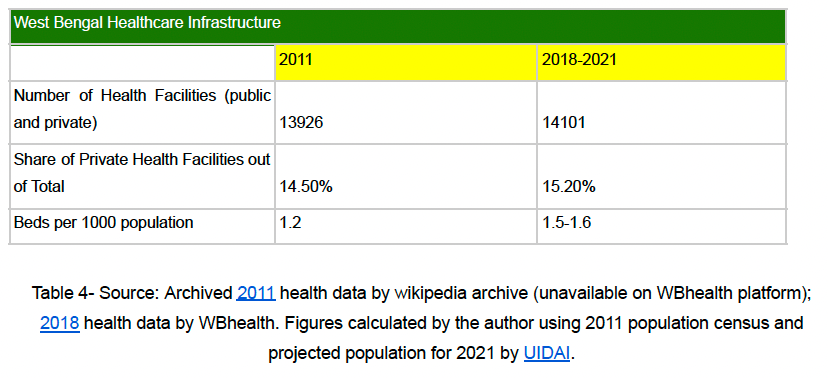
While under the TMC health infrastructure has shown minor improvements, in contrast Kolkata is the city with the least bed per 1000 population compared to 7 other major cities (Bangalore, Pune, Ahmedabad, Chennai, Hyderabad, Mumbai and Delhi). While the overall bed to per 1000 population improved from 1.2 in 2011 to 1.5-1.6 in 2018-21, the share of private facilities out of total facilities also increased by a point.
Relative Stagnation in West Bengal Health
Other states that were once lagging behind West Bengal, and sometimes the national average, have caught up and improved faster than Bengal has in the same period. This coincides with the tenure of Mamata Banerjee leading the health ministry, a role for which she has been criticised in the wake of the RG Kar protests. Notably, states such as Telangana, Andhra Pradesh, Jharkhand, Gujarat and even Rajasthan which were poor performers at the start of this century, have crossed Bengal and improved their performance. In the meantime, high performing states such as Kerala, Tamil Nadu and Maharashtra have maintained their relative position through the two decades.
This likely speaks towards a stagnancy in the health trajectory of Bengal, even as flagship health welfare schemes such Swasthya Sathi are a prominent electoral promise by the TMC government. However, under this scheme, various complaints regarding missing desks, unfulfilled coverage and denials have been reported by beneficiaries. The governance of this scheme suffers from a form of survivor's bias, where official data is only collected for claims that have been registered- whereas data for claim refusals does not exist. This makes it difficult to assess the efficacy of the scheme, and critics are left to rely on anecdotal incidents. Reportage in this regard has shown that the scheme fails the private hospital test, where numerous private hospitals have complained about it not being financially feasible and therefore shutting down their Swasthya Sathi desks. Additionally, the scheme is only effective for certain types of operations, leaving the rest of the ailments to be dealt with by public hospitals and out-of-pocket expenditure.
Other issues also highlight the issues in the Bengal health sector, especially during Covid, when doctors alleged that the government was under-reporting or preventing the reporting of Covid cases. This holds up against the recently released report that showed Bengal had around 86,000 excess Covid deaths- four times the reported amount for the state. In the light of the RG Kar incident, infrastructure deficiencies, missed payments, and corruption in medical colleges across the state were also highlighted by critics, news media, political opposition and civil society.
Conclusion
While the CPIM-ruled Left should rightly be critiqued for low public health expenditures and imperfect infrastructure, the indicators and comparison for that era definitely highlights how Bengal was building a strong healthcare base, especially after starting from a low base in the 70-80s. In this regard, the Left Front did a commendable job on key health indicators, and routinely improved their rank in the country through the 90s and early 2000s, losing out only to states such as Kerala (which has a brilliant health record), Tamil Nadu and Maharashtra. In 2011, the TMC inherited a strong healthcare system- a privilege that the Left Front did not enjoy in 1977. In this time, the TMC has not once improved its position relative to other states, and in many cases dropped relatively further below its previous ranks. In contrast, the Left Front regularly improved its position since the 80s.